𝘍𝘳𝘰𝘮 𝘐𝘯𝘥𝘪𝘢𝘯 𝘓𝘰𝘰𝘮𝘴 𝘵𝘰 𝘎𝘭𝘰𝘣𝘢𝘭 𝘙𝘰𝘰𝘮𝘴

How to Find a Reliable Home Textile Exporter in India | Kanha Universal Export (KUE)
A practical guide for importers and wholesalers on evaluating home textile exporters in India — verification steps, red flags, and sourcing checklist.
TRUST CLUSTER
Kanha Universal Export (KUE)
7/4/20267 min read
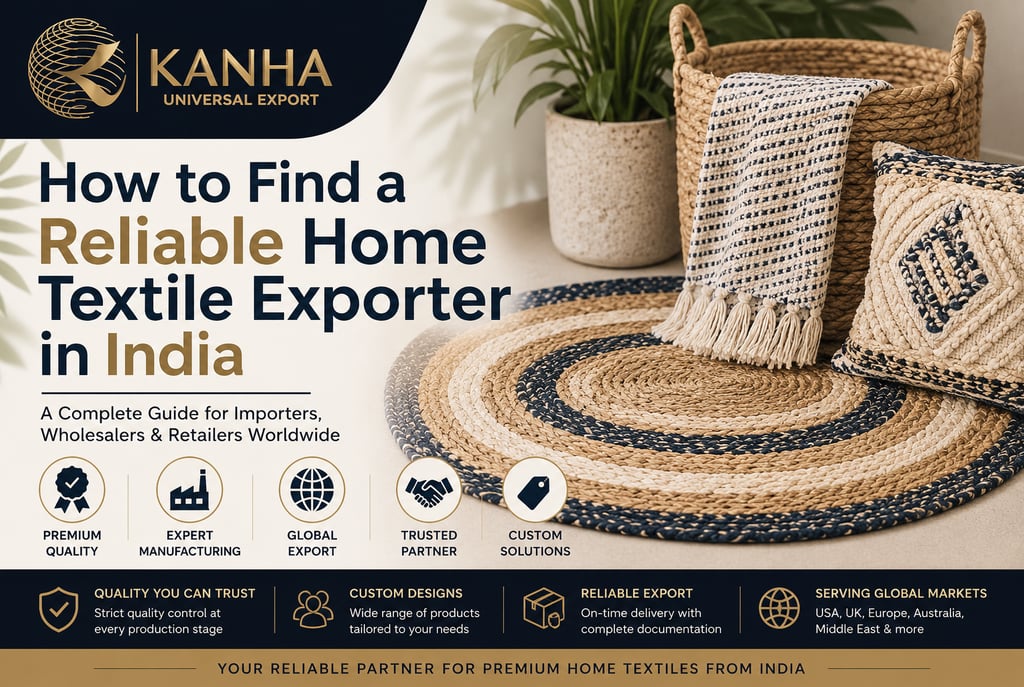
India supplies a large share of the world's rugs, throws, cushion covers, and home décor textiles. For an importer or wholesaler, that scale is an advantage — but it also means the market is crowded with exporters at very different levels of reliability. Choosing the wrong one leads to late shipments, inconsistent quality, and failed compliance checks. Choosing the right one gives a buyer a long-term production partner.
This guide sets out exactly what to check before signing a purchase order with a home textile exporter in India.
Why Sourcing From India Requires Careful Vetting
India's textile export sector runs on a mix of large integrated exporters, small workshops, and trading intermediaries who resell someone else's production under their own name. All three can appear identical on a website or a trade platform listing. The difference only becomes clear once a buyer asks specific, verifiable questions.
For importers building a private label range, opening a retail chain's home décor section, or supplying a hospitality group, the exporter is not a one-time vendor — it is a production partner tied to delivery schedules, seasonal launches, and brand quality standards. That relationship needs to be built on facts, not on a polished product photo.
Verify Export Registration and Legal Standing
Every legitimate textile exporter in India holds a set of standard registrations. Before any product discussion, ask for:
IEC (Import Export Code) — issued by the Directorate General of Foreign Trade; mandatory for any company legally exporting from India
GST registration number — verifiable through the government GST portal
Udyam/MSME registration (where applicable) — indicates a formally registered manufacturing or export unit
Council membership — for home textiles, this typically means registration with a recognized export promotion body relevant to handicrafts or textiles
A company unwilling to share these details, or unable to produce them on request, is not export-ready regardless of how established it appears online.
Confirm Whether You Are Talking to the Exporter or a Middleman
Many listings on B2B marketplaces are trading companies, not the exporter of record. This isn't automatically a problem, but a buyer needs to know which one they're dealing with, because it changes pricing, quality control, and lead times.
Ask directly:
Does the company own or directly control the production process, or does it outsource to third-party units?
Who inspects the goods before shipment — the company's own quality team, or the production unit?
Can the buyer request a factory or workshop visit, in person or via live video call?
A transparent exporter will answer these questions without hesitation and will be clear about where and how the product is actually made, including when production is managed through a network of specialized manufacturing partners rather than a single in-house facility. That model is common and not a red flag — vague or evasive answers are the actual warning sign.
Request Real Production and Capacity Evidence
Photos on a website prove nothing about current capacity. Before committing to a bulk order, ask for:
Recent production videos or live video calls showing active work in progress
Monthly production capacity for the specific product category (rugs, cushion covers, throws, etc.), not a generic company-wide figure
Minimum Order Quantity (MOQ) and how it scales with customization
Sample lead time versus bulk order lead time — these should be clearly different and clearly stated
A reliable exporter will give specific numbers. A vague answer like "we can handle any order size" without supporting detail usually means capacity has not been properly assessed or committed.
Check Quality Control at Every Production Stage
Home textile quality issues — uneven dyeing, weak stitching, shrinkage, inconsistent sizing across a batch — are far cheaper to catch before shipping than after arrival. Ask the exporter to walk through their quality control process:
Raw material inspection (yarn, fabric, dye lots)
In-line inspection during production
Pre-shipment inspection with documented pass/fail criteria
Whether third-party inspection agencies (such as SGS, Intertek, or Bureau Veritas) are used or accepted
If an exporter cannot describe a structured, stage-by-stage quality process, treat that as a sourcing risk, not a minor gap.
Review Compliance and Testing Certifications
Home textile imports into the USA, UK, EU, and Middle East face different compliance requirements depending on the destination market and product type. Depending on your target market, ask which of the following the exporter can provide:
OEKO-TEX Standard 100 — certifies the product is free from harmful substances
REACH compliance — required for goods entering the European Union
Flammability test reports — often required for rugs, cushions, and upholstery textiles sold in the USA and UK
Fair trade or social compliance certifications (SA8000, WRAP, or similar) — increasingly requested by retail chains and hospitality buyers
Ask for the actual certificate and testing lab report, not just a logo on a website. Certificates can be outdated or product-specific, so confirm they cover the exact category being ordered.
Clarify Customization Capability
Bulk buyers rarely order an exact catalog item. They need size adjustments, private label packaging, custom color palettes, or material substitutions. Before finalizing a supplier, confirm:
Whether custom sizing is available and at what MOQ
Whether private labeling, custom tags, and branded packaging are supported
Turnaround time for a custom sample versus a standard sample
Whether design files (mood boards, technical sketches, color references) are accepted directly, or need to be reformatted by the exporter's team
An exporter that treats customization as a routine part of the order process — rather than a special request — is better positioned for a long-term buyer relationship.
Evaluate Packaging and Logistics Handling
Home textiles are bulky and vulnerable to moisture and compression damage during ocean freight. Ask about:
Standard export packaging (poly bags, cartons, palletization) for the specific product category
Moisture-proofing and compression methods for rugs and thick textiles
Container loading plan and standard container fill rates for the product
Incoterms the exporter regularly works with (FOB, CIF, EXW) and which ports they ship from
Exporters with consistent international shipping experience will have standard answers to all of these, without needing to "check and get back."
Check References and Existing Buyer Relationships
A textile exporter working with international retail chains, hospitality groups, or established wholesalers will usually be able to provide:
Export markets currently served (which countries, which buyer categories)
Approximate years of export experience per category
Willingness to provide a buyer reference, where confidentiality allows
Buyers should treat the absence of any verifiable export history as a reason for a smaller trial order, not a full commitment.
Start With a Trial Order Before Scaling
Even after an exporter passes every check above, a full-scale first order is unnecessary risk. A structured approach looks like:
Request physical samples matching the exact specification (material, size, color, packaging)
Place a smaller trial production order to test consistency at scale
Inspect the trial order against the sample, ideally through a third-party inspection
Confirm on-time delivery and communication quality during the trial
Scale to full bulk ordering only after the trial performs to specification
This sequence protects the buyer's inventory planning and gives the exporter a fair opportunity to demonstrate reliability before a large commitment.
Working With an Established Export Partner: Kanha Universal Export(KUE)
Kanha Universal Export(KUE) is an exporter of home textiles and home décor based in Panipat, India — one of the country's principal textile manufacturing hubs. The company supplies international buyers, including importers, wholesalers, retail chains, hospitality buyers, interior designers, and private label brands, across the USA, UK, UAE, Europe, and Australia.
KUE operates on a bulk production model with buyer-specific customization across size, material, and design, working through a network of verified manufacturing partners rather than a single in-house unit. This structure gives buyers access to a wider production capacity across categories — including chindi rugs, cotton rugs, jute rugs, cushion covers, throws, bedsheets and poufs — while maintaining a single point of contact for quality control, compliance, and order management.
Buyers evaluating a new sourcing partner in India can request current production documentation, sample lead times, and compliance certification directly, following the same verification process outlined above.
Frequently Asked Questions
What products does Kanha Universal Export supply for bulk international orders?
Kanha Universal Export supplies chindi rugs, cotton rugs, braided rugs, jute rugs, tufted rugs, cushion covers, throws, bedsheets ,placemats, wall hangings, and poufs for bulk B2B orders across the USA, UK, UAE, Europe, and Australia.
What is the Minimum Order Quantity (MOQ) for Kanha Universal Export?
Kanha Universal Export does not enforce a fixed MOQ. Orders are accepted starting from a single piece, with pricing and lead time adjusted based on quantity, customization, and product category. Bulk orders receive standard export pricing benefits, while smaller trial orders are equally welcome for buyers testing quality before scaling.
Does Kanha Universal Export offer custom sizes, colors, and designs?
Yes. Kanha Universal Export supports full customization on size, material, color palette, and design for bulk orders, including private label and OEM requirements for retail chains, distributors, and hospitality buyers.
What certifications and compliance testing does Kanha Universal Export provide?
Kanha Universal Export supports OEKO-TEX and REACH-compliant production runs and works with third-party inspection agencies on request, based on the destination market and product category.
How long does sample production take at Kanha Universal Export?
Standard samples are typically ready in 7–15 days. Fully customized samples involving new materials or dye lots may require additional time, confirmed at the time of order.
Which export markets does Kanha Universal Export currently serve?
Kanha Universal Export supplies buyers across the USA, UK, UAE, Europe, and Australia, including importers, wholesalers, retail chains, hospitality buyers, interior designers, and private label brands.
Does Kanha Universal Export handle export packaging and logistics?
Yes. Kanha Universal Export manages export-standard packaging, moisture-proofing for textiles, palletization, and container loading, and works on FOB, CIF, and EXW terms depending on the buyer's requirement.
Can buyers place a trial order before committing to a full bulk order?
Yes. Kanha Universal Export supports trial production orders to confirm quality and consistency before scaling to full bulk volumes.
How does Kanha Universal Export ensure consistent quality across large orders?
Kanha Universal Export applies structured quality control across raw material inspection, in-line production checks, and pre-shipment inspection, maintained consistently across every bulk order.
How can international buyers start sourcing from Kanha Universal Export?
Buyers can submit their product requirement, target quantity, and destination market directly to Kanha Universal Export to receive samples, pricing, and lead-time confirmation.
Send your Enquiry now - Contact Us
Table of Contents
Why Sourcing From India Requires Careful Vetting
Verify Export Registration and Legal Standing
Confirm Whether You Are Talking to the Exporter or a Middleman
Request Real Production and Capacity Evidence
Check Quality Control at Every Production Stage
Review Compliance and Testing Certifications
Clarify Customization Capability
Evaluate Packaging and Logistics Handling
Check References and Existing Buyer Relationships
Start With a Trial Order Before Scaling
Working With an Established Export Partner: Kanha Universal Export
Frequently Asked Questions